Wednesday, March 23, 2016

Fourth Sunday of Lent C


January 31, 2016


If God were the owner of a sports team, it might seem to us as if God had a way of picking up mostly second- and third-rate players.
God never seems to go for the tried and true, the top of the heap or the best in the bunch.
Whenever God calls forth believers and followers, God picks the youngest, the forgotten, the overlooked, the sinner, the enemy or the blind.
The list of who God trusts and has confidence in doesn't always include the credentialed and prominent from this world's list of Who's Who.

In today's Gospel we read about the healing of the man who was born blind.
In the cultural world of first-century Palestine, blindness was regarded as a sign of sin, either by one's parents or by the person himself.
The disciples ask Jesus whose sin caused the man's blindness.
Jesus responds by choosing to make the blind man a sign of God's power.
He cures him of his blindness and, when the man returns, able to see,
what follows is one of the liveliest exchanges in the Gospel, full of complicated characters and intriguing debate.
Jesus chose a seemingly inconsequential character to reveal his role as the light of the world.
By the end of this story the blind man will make a profession of faith and give praise and honor to God in the face of outright contempt.

Consider the cast of characters in this story:
There are neighbors who have only known the blind man as a beggar.
Yet they all have different perceptions and can't even agree if this healed man is the same person.
Like witnesses to a traffic accident, they are not sure what they have witnessed.
The Pharisees arrive, concerned that Jesus healed the blind man on the Sabbath, breaking the law.
But even they can't agree on whether Jesus himself is a sinner.
The parents of the man were summoned.
They don't want to commit themselves because they know this can get them ostracized.
So they put it back on their son: "He can speak for himself'
The Pharisees ask-again, "What did he do to you? How did he open your eyes?"
The man born blind, now able to see, stands before the mall, reaffirming his story: "One thing I do know is that I was blind and now I see ... I told you already and you did not listen. Why do you want to hear it again?"

In the end, after a pointed theological discussion with the authorities about their inability to see that Jesus was from God; they throw him out.
Instead of acknowledging the obvious power of an unheard of miracle — the healing of a man born blind — the authorities fall back on their assumptions about who is a sinner:
"You were born totally in sin and are you trying to teach us?"
They learn nothing from this man.
He is in that category with the youngest, the forgotten, the overlooked, the sinner, the enemy.
Yet he is chosen by Jesus to be a faithful witness to the power :and glory of God: "I do believe," he says, beholding the face of the Messiah.

You and me, we are among these characters on whom God bets the future.
At times my disbelief clouds my faith.
My arrogance about the rightness of my way blocks my conviction that God acts differently than I expect.
At times I am afraid of being ostracized and keep my faith hidden.
As I pass the halfway mark of my Lenten journey toward Jerusalem, I ponder these stories and thoughts.
By continuing my Lenten journey, I am submitting my own blindness to Jesus.
I am clinging to Paul's words: "Awake, O sleeper, and rise from the dead, and Christ will give you light," as I whisper: "I do believe."

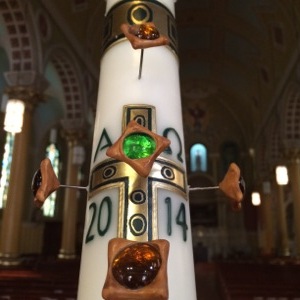
Tuesday, March 22, 2016

Welcome to Holy Week


published 27 March 2015 by Richard J. Clark
ELCOME TO Holy Week. For many, preparations have been well underway and are still ongoing. But once the onslaught of liturgies begins, it’s a bit like the morning of a final exam: One can’t study or prepare anymore. Just be in the best mental and physical state possible. For us, that also includes spiritual.
So, why do we work so hard to prepare? Beyond the technical preparations, musical and liturgical, there are five essential things music directors should remind themselves, their choirs and instrumentalists:

1. WE WILL AFFECT PEOPLE IN WAYS WE WILL NEVER KNOW.
There are those who walk through the doors of our churches who carry burdens unknown to us. Sorrow, struggle, and suffering permeates our fragile existence, but so does joy. There is great opportunity for comfort, compassion and love. In prayerful, loving song, you may forever change the lives of someone you do not know in a way you will never know.
Furthermore, for Elect and Candidates of the Church, the Easter Vigil is a night of life-changing importance. Your prayerful support, now, and during the period of mystagogy is critical.

2. THIS IS SOMETHING WE DO TOGETHER AS A CHURCH
While individuals may be experiencing different things in their personal lives, we are united in the Body of Christ. We are not only part of our local parish, but part of the Universal Church. This unity and universality is, in part, why our worship is ritualized. We are connected not only with our neighbors beside us, but with our brothers and sisters around the world. We are connected not only in the present day, but with the old Covenant with Abraham to the new Covenant mediated by Christ, so that we “may receive the promise of an eternal inheritance” (Heb 9:15) in the future.
In part this unity is why our sacred music ideally conveys a sense of timelessness and universality. Christ yesterday and today… All time belongs to Him…
Likewise, in this unity, everyone in your choir is important—not just those with more beautiful voices. We’re all singing and praying together.

3. EVERY TECHNICAL DETAIL—EVERY REHEARSAL IS A PRAYER
This is the Martha side of things. There is an overwhelming amount to do, but be mindful that all the tedious work and attention to detail is in service to the liturgy. It is in service to God and a great service to your sisters and brothers in the community.
But when the time comes, don’t worry about mistakes. Glitches will arise. Move on in prayer and don’t look back.

4. TAKE TIME FOR SILENCE.
This is the Mary side of things. Being constantly busy is its own kind of addictive drug designed to distract us from pain and even sometimes from joy! (Being emotional is hard work.) At the end of your pre-liturgy warmup or rehearsal, be sure to leave the choir several minutes for quiet reflection and prayer. If desired, part of that time can also be used to look over a score of the first piece or two. Sing the incipit in your head. Then close the book.
Remember to allow room for the Spirit, for both musical and prayerful inspiration. Place yourself in the center of the music and revel in every moment of prayer that comes forth. In achieving this end, the value of stillness and silence cannot be underestimated.

5. GIVE THANKS.
Expressing gratitude should become a mindful habit. Choirs can never be thanked enough. Of all the ministries of your church or parish, those in the choir usually volunteer the greatest number of hours all year round. So, thank your choir now, and always.
Consider how lucky we are to have people in our lives not only to make music with, but to pray with. To do so at the same time is an extraordinary privilege. Don’t forget it, and never take it for granted.
So, get on your knees and thank God for the gift of music, through which we may sing His praises, comfort the distressed, and experience the boundless joy of God’s love.
And while you’re at it, thank your choir. Again.

Really? We weren't invited?


Is the abundant service of women insufficiently acknowledged in the church?
By Jessica Mesman Griffith, the author of three books, including Love and Salt: A Spiritual Friendship in Letters (Loyola Press).
Please take the survey that follows this essay.
On January 21st of this year, the Vatican announced a change to the Roman Missal, per the request of Pope Francis, that women would no longer officially be excluded from the foot washing ritual during Holy Thursday Mass.
A great many Catholics (myself included) responded, “Huh?”
I had no idea women weren’t invited.
I’m turning 40 this year, and as a lifelong Catholic, I can’t remember a Holy Thursday Mass in which women were excluded from the foot washing. Even 30 years ago in my home parish—where girls were still not allowed to serve at the altar—women had their feet washed alongside men. The invitation of a diverse sample of the parish always seemed to me to communicate the rich metaphorical meaning of foot washing: our priest follows the example of Christ and acts as our servant, not our worldly ruler.
In the Gospel of John, Jesus washes the feet of the 12 apostles during the Last Supper and says:
“Do you know what I have done for you? You call me Teacher and Lord—and you are right, for that is what I am. So if I, your Lord and Teacher, have washed your feet, you also ought to wash one another’s feet. For I have set you an example, that you should do as I have done to you. Very truly, I tell you, servants are not greater than their master, nor are messengers greater than the one who sent them. If you know these things, you are blessed if you do them.”
Foot washing, like so many of our liturgical rituals, has many layers of significance. Historically, it was a practical ritual for people coming into homes after walking barefoot in the desert. To me, it also connotes ritual cleanliness, baptism, and the necessity of coming clean to the Eucharistic table. And in the washing of one another’s feet, we experience God’s grace.
But most significant, considering the papal decree, is that Holy Thursday Mass (where all this foot washing takes place) is also called the Mass of the Lord’s Supper. It is, first and foremost, when we celebrate the gift of the Eucharist that Christ gave us at his last supper. According to the Missal, it’s also when we remember that Christ gave us the priesthood. Because while the historical Jesus never ordained anyone, we believe that in this act of service to his disciples, he was showing how his own sacrifice should be remembered by his followers.
In the Roman Catholic tradition, theologians have been connecting Jesus’ humble act to priestly service for centuries. Foot washing by priests, according to the Missal, recalls Jesus’ service in the upper room, linking Jesus of Scripture to our current understanding of ordained ministry. It also evokes a patriarchy that dates back to the 12 apostles and to the 12 fathers of the 12 tribes of Israel before them.
Because foot washing is associated with an understanding of ordained ministry, some Catholics have insisted that it remains a ritual reserved for priests—one that should take place only in a church and exclude women and non-Catholics.
But Pope Francis challenged that interpretation when he celebrated Holy Thursday Mass last year in a detention center and washed and kissed the feet of women, addicts, and a Muslim man. Though many Catholics applauded his actions, others were upset and said that the pope was “breaking the rules.”
So in December of 2015 Pope Francis requested that the head of the Congregation of Divine Worship and Discipline of the Sacraments Cardinal Robert Sarah change the instructions in the Roman Missal, the compendium of the official Roman Catholic liturgical practices and prayers.
Cardinal Sarah agreed and announced that change in January.
I admit, I first responded to the decree with an eye roll. The exclusion of non-Catholics from a Catholic rite was not all that surprising, but I was miffed to find out that until January 21, 2016, the church didn’t explicitly allow for my participation in one of our most beloved rituals, and that priests can still opt out of the ritual altogether if they don’t want to include women.
In so many parishes, women are routinely underserved and overworked. We’re in charge of everything—RCIA, catechesis, the choir, the bulletin, the food pantry. Sometimes these are paid positions. Often they’re not. Women are the church’s willing servants. Who better to have her feet washed than the woman with five children under the age of seven who misses most of  Mass every week because she’s been asked to run the parish nursery?
Women also tend to anticipate the work that needs to be done and do it long before we’re “officially” asked. I recently interviewed a group of so-called “green nuns” who have worked for decades, often under scrutiny from church officials, on exactly the kinds of care for the earth that Pope Francis called for in his recent encyclical, Laudato Si’. They struck me as representative of so many Catholic women I know who labor unsupported and unacknowledged by the church we love. This seemed like just one more case in which the “official” church came too late to the party, and it stung a little.
Thanks for inviting us; we’re already here. Especially because the United States Conference of Catholic Bishops has officially allowed the foot washing of women since 1987.
It’s true. That’s exactly how the Catholic Church works. It arrives late. It is infuriatingly—and blessedly—slow to change. This is both the price and the reward of belonging to an ancient church. It guards traditions. Sometimes too closely. And sometimes it ignores traditions it would rather not embrace. But Francis’s decree reminds us that it can, and does, and should change.
As Father Antonio Spadaro tweeted in response to the pope’s foot washing decree: “small steps are also taken with feet (and step by step).”
- See more at: http://www.uscatholic.org/womenfootwashing?utm_source=Copy+of+March+12%2C+2016&utm_campaign=March+19%2C+2016&utm_medium=email#sthash.nrS1981N.dpuf

Monday, March 14, 2016

Third Sunday of Lent C


Image: Milles, Carl, 1949-1953. 
God's Hand
, from Art in the Christian Tradition,
a project of the Vanderbilt Divinity Library, Nashville, TN.


February 28, 2016

In the Gospel for Sunday Jesus sounds angry and threatening. “Repent or you will perish.” cursing a fig tree, the tower at Siloam falling on eighteen people; etc.
Is the loving Lord we have known actually furious and offended?
Let us look.
News comes to Jesus that Pilate has murdered a number of Galilean people.
Still worse, Pilate has mixed their blood with that of sacrificed animals. This is a terrible, gruesome story, worthy of denunciation.
Jesus as we know him should object.
But he draws a point from it:
Do you think that because these Galileans suffered in this way they were greater sinners than all other Galileans?
By no means! But I tell you, if you do not repent, you will all perish as they did!

What is the logic here?
It seems you don’t have to murder people in order to get punished.
You can qualify just by failing to repent!
Why is Jesus so harsh? Is he an angry savior?
Was he punishing in the same way that a lot of people think the God of the Old Testament was?
Unforgiving, warlike, furious, demanding an infinite sacrifice to make up for humankind’s sins against an infinite God?

No. On the contrary, when we look at the First Reading, we do not find an irate God at all.
Instead, we find a tender one, grieving over the troubles of his people.
I have witnessed the affliction of my people in Egypt and have heard their cry of complaint against their slave drivers, so I know well what they are suffering.
Therefore I have come down to rescue them.

Miraculously, God speaks these words to Moses from the midst of a burning bush that is not consumed by its own flames!
He begins to instruct Moses about how to rescue God’s people.
Great compassion from the depths of the transcendent God.
Didn’t Jesus have the same kind of compassion for his own people?
He tells a parable in the second half of the Gospel that might help us understand.

An orchard owner orders his gardener to chop down a sadly unproductive fig tree.
The laborer advises him to leave it one more year and see if, with some tending, it will bear fruit.
Give it one more chance.
Who does the heartless orchard owner represent?
We always assume that it is God.
We half-remember the story in Mt 21:18-19 of Jesus actually cursing a fruitless fig tree.
But, on the contrary, Jesus is not the orchard owner at all, but the gardener, asking mercy for the disobedient fig tree.

Isn’t this exactly what he is doing when he warns that the people will perish if they don’t repent?
Isn’t he shouting at all of us to turn back to God in order to avoid destruction?
Yes. He is “startling the poor sheep back” from the edge of the cliff (to paraphrase the poet Hopkins), and you and I are the sheep.**
There is still reason to fear God, of course, since he is infinite and infinitely more fiery than the burning bush.
But the closer you come to the real center of God, the more your fear turns to gratitude.
You are not scalded or consumed by the divine fire—you are warmed and gentled at its welcoming hearth.

Jesus’ tough love leads us to that hearth.

Second Sunday of Lent C

Image: Hofheinz-Doring, Margret, 1910-1994. 
Endless Road
, from Art in the Christian Tradition, 
a project of the Vanderbilt Divinity Library, Nashville, TN.

February 21, 2016

“Lent is a time of prayer, but not for gloomy faces.  Some people choose to give things up, but that’s a matter of personal piety.  Many parishioners choose to add something, like prayer or extra worship services, or take on a cause.” – Diane Archer

Give up something during Lent?  
How old fashion!  Really?  
Yet as life goes on we often give things up as we slump into the dark side.  
Have we given up eating healthy, thinking we have to die of something?  
Have we given up exercise in our laziness?  
In our cynicism have we given up respecting our leaders refusing to see any sincerity or honesty in them?  
Have we given up voting?  
In our weak faith have we given up praying?  
In our self-centeredness have we given up relating to our neighbors, even to those next door?  
Name our own. 
Giving up is not old fashion. 
We do it all the time.  
The reversal of any of these things would be to take on a cause.  

In today’s Gospel Jesus mentions something that we commonly give up: prophets.  
Jesus is on his way to Jerusalem, even after being warned, because that is where prophets are killed (Luke 13:33).  (See Greek below)  

Who are our prophets?  
We might mention Martin Luther King, Jr.  
But he is dead, assassinated in Memphis, Tennessee, his Jerusalem.  
We might mention Mohandas Gandhi.  But he is dead, assassinated in New Delhi, India, his Jerusalem.  

The prophets are always marching on to their unique Jerusalem to die.  
Sure, we honor them after their demise, having refused to listen to them during their lives.  
But who are the prophets living today?  
Have we given up looking for them?  
Have we killed them by our indifference?  
So here is a cause to take on this Lent.  
Let’s look for the prophets.  
They might be some public social figure like King or Gandhi.  
But perhaps the prophet might just be the person next door with a word just for us.

Most translations of Luke 13:33 say that it is “impossible” for a prophet to be killed outside of Jerusalem.  However, the Greek literally says that it cannot “be received in.”  The word communicates the idea that we can’t, to use an expression, wrap our minds around it.  It’s unthinkable, which is different than impossible.  Perhaps the best published translation is found in the New Jerusalem Bible, “It is not right” for a prophet to die outside of Jerusalem.  Jerusalem has become the metaphoric place where prophets are killed.  Jerusalem can be anywhere.
Haiku
Today, tomorrow,
Jerusalem, our home town.
Prophets die again.


First Sunday of Lent C


February 14, 2016

In her biography, The Long Loneliness, Dorothy Day shares how, shortly after her conversion to Catholicism, she went through a painful, desert time.
She had just given birth to her daughter and her decision to have the child baptized, coupled with her profession of faith, meant the end of her relationship with a man she deeply loved. S
he suddenly found herself alone.
All her old supports had been cut off and she was left with no money, no job, few friends, no practical dream, and no companionship from the person she loved the most deeply in this world.
For a while she just stumbled on, trusting that things would soon get better.
They didn’t. She remained in this desert.

One day, not knowing what else to do, she took a train from New York to Washington to spend a day praying at the National Shrine of Our Lady.
Her prayer there was wrenching, naked.
She describes how she laid bare her helplessness, spilling out her confusion, her doubts, her fears, and her temptations to bitterness and despair.
In essence, she said to God: “I have given up everything that ever supported me, in trust, to you.
I have nothing left to hold on to.
You need to do something for me, soon.
I can’t keep this up much longer!”
She was, biblically speaking, in the desert—alone, without support, helpless before a chaos that threatened to overwhelm her—and, as was the case with Jesus, both in the desert and in Gethsemane, God “sent angels to minister to her.”
God steadied her in the chaos.
She caught a train back to New York and, that very night, as walked up to her apartment she saw a man sitting there.
His name was Peter Maurin and the rest is history.
Together they started the Catholic Worker.
We should not be surprised that her prayer had such a tangible result.
The desert, scripture assures us, is the place where God is specially near.

Martin Luther King shares a similar story. In Stride Towards Freedom he relates how one night a hate-filled phone call shook him to his depths and plunged him into a desert of fear. Here are his words:
An angry voice said: “Listen, nigger, we’ve taken all we want from you; before next week you’ll be sorry you ever came to Montgomery.”
I hung up, but I couldn’t sleep.
It seemed that all of my fears had come down on me at once.
I had reached the saturation point.
I got out of bed and began to walk the floor.
Finally I went to the kitchen and heated a pot of coffee.
I was ready to give up.
With my coffee sitting untouched before me I tried to think of a way to move out of the picture without appearing a coward.
In this state of exhaustion, when my courage had all but gone, I decided to take my problem to God.
With my head in my hand, I bowed over the kitchen table and prayed aloud.
The words I spoke to God that midnight are still vivid in my memory.

I am here taking a stand for what I believe is right.
But now I am afraid.
The people are looking to me for leadership and if I stand before them without strength and courage, they too will falter.
I am at the end of my powers.
I have nothing left.
I’ve come to the point where I can’t take it alone.”
At that moment I experienced the presence of the Divine as I had never experienced Him before.

God sends his angels to minister to us when we are in the desert and in the garden of Gethsemane.
This incident in Martin Luther King’s life demonstrates how.

The desert, as we know, is the place where, stripped of all that normally nourishes and supports us, we are exposed to chaos, raw fear, and demons of every kind.
In the desert we are exposed, body and soul, made vulnerable to be overwhelmed by chaos and temptations of every kind.
But, precisely because we are so stripped of everything we normally rely on, this is also a privileged moment for grace.
Why? Because all the defense mechanisms, support systems, and distractions that we normally surround ourselves with so as to keep chaos and fear at bay work at the same time to keep much of God’s grace at bay.
What we use, to buoy us up, wards off both chaos and grace, demons and the divine alike.

Conversely, when we are helpless we are open.
That is why the desert is both the place of chaos and the place of God’s closeness.
It is no accident that Dorothy Day and Martin Luther King felt God’s presence so unmistakably just at that point in their lives where they had lost everything that could support them.
They were in the desert.

Scripture assures us that it is there that God can send angels to minister to usClick here for scripture readings

Ash Wednesday C

Image: "Blessing the Dust" © Jan Richardson

February 10, 2016

“The last temptation is the greatest treason: To do the right deed for the wrong reason.”
This quote from T.S. Eliot comes in a play where a saint is tempted by many things but does not give in, and then the final temptation arrives: “To do the right deed for the wrong reason.”
If Satan could convince us to not fast at all this Lent, he would.
If not, he will try to get us to fast in a silly way, to give up chocolate chip cookies for Lent, as we eat brownies instead, or, perhaps, we obey the abstinence from meat on Fridays by having a feast of shrimp and lobster.
If we are not taken in by any of this, the last temptation comes: “to do the right deed for the wrong reason.”
We fast, in order to impress people.
We fast, in order to lose weight.
We fast, in order to fulfill some New Year’s resolution.

Jesus told us to love God above all things and to love our neighbors as ourselves.
 Love is the heart of Christianity, but our love is weak and disordered. We do not love God with all our heart and soul and strength, so we need to spend time in prayer this Lent.
We do not love our neighbors who are created by God, our brothers and sisters, so we need to give away that which we love more than them, our money and our time.
We do love ourselves, but we love ourselves in the wrong way;
we should love ourselves like parents, with some discipline, having our best interest at heart, but, instead, we love ourselves like senile grandparents, over-indulging ourselves with candies and toys, so we need to start refusing ourselves treats sometimes.
Prayer, fasting, and almsgiving are good for us.
They should hurt.
Our souls complain about being unselfish.
Do not give in to the complaints!
Our souls warn us that this is too much, too much prayer, fasting, and almsgiving; it will kill us: without selfish indulgence, we will die.
Good! Let us die.
Let us be nailed to the Cross with our Savior.
Then, when Easter comes, he can raise us up.

Our souls are flabby and out of shape.
The combined effect of all the sins we commit is a puny, scrawny, pathetic souls.
We are in serious need of spiritual exercise: prayer, fasting, and almsgiving.
If we make feeble attempts, we will get feeble results.
It is 44 days from now until we celebrate the Easter Triduum, we get 4 days of introduction and then, on Sunday, the 40 days of Lent begin.
The lazier we are, spiritually, the rest of the year, the more seriously we should look to these days as a time of intensive effort, for the soul.

If we are going to make this intensive effort, we had better be sure that we are doing it for the right reason.
If we fast and tell people about our fasting,
if we give to the poor our money or our time and make certain that the world is aware of our generosity,
 if we pray so that others will see us, all that effort will be wasted.
Only our pride will be strengthened; our souls will be weakened further.

Let us pray until we fall head-over-heels in love with God.
Let us give away our money and time until we begin to love our neighbors as ourselves.
Let us fast until our love for ourselves is no longer self-indulgent.
When we look out and see the canyon between us and heaven, we want to move forward, we want to take the leap of faith, but we are afraid, afraid of many things, but especially frightened that we will begin to live a new life and soon fail and be laughed at for ever trying.
Lent is our training ground, our opportunity to try out the life of the Saints.

If we cannot be perfect all year-round, let us try to be as perfect as possible for forty days straight.